
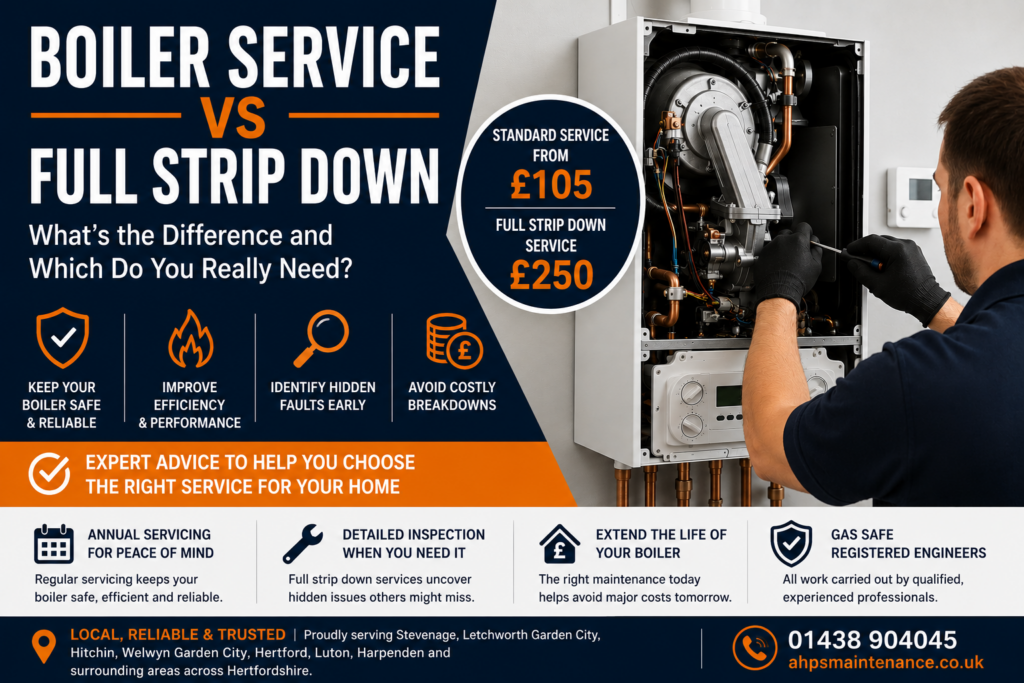
When comparing a boiler service vs a full strip-down, many homeowners assume the more extensive option is automatically better. In reality, the right choice depends on your boiler’s condition, age, performance, and service history.
For most homes, an annual boiler service carried out by a qualified Gas Safe engineer is enough to keep a boiler operating safely and efficiently. Regular boiler servicing helps identify wear and tear, maintain boiler efficiency, and reduce the likelihood of unexpected breakdowns.
A full strip-down boiler service is different. It involves dismantling and inspecting key internal components that are not normally removed during a standard service. While this can provide a more in-depth assessment of your boiler’s condition, it is not something every property needs each year.
Understanding the difference is important because the cost varies significantly. At AHPS Maintenance, a Standard Boiler Service costs £108, while a Full Strip Down Service costs £250. Choosing the correct service ensures you’re investing in the level of maintenance your heating system actually needs.
In this guide, we’ll explain exactly what each service includes, when a full strip down is genuinely worthwhile, and how to decide which option offers the best value for your home or property. The aim is simple: help you make an informed decision that protects your boiler, your heating system, and your budget.
Boiler Service vs Full Strip Down: The Quick Answer
If you’re comparing a boiler service vs full strip down, the simple answer is that most homeowners only need a standard annual boiler service.
A standard boiler service is designed to check that your boiler is operating safely, efficiently, and in line with manufacturer recommendations. It includes safety checks, performance testing, visual inspections, and identification of developing faults before they become expensive repairs.
A full strip-down boiler service goes much further. It involves dismantling key internal components so they can be cleaned, inspected, and assessed in greater detail. This level of maintenance is usually recommended when there are signs of performance issues, contamination, recurring faults, or when an engineer needs a closer look at internal parts.
The table below provides a quick comparison:
| Standard Boiler Service | Full Strip Down Boiler Service |
|---|---|
| Recommended annually | Recommended when required by condition |
| Safety and performance checks | Deep internal inspection and cleaning |
| Helps maintain manufacturer requirements | Helps investigate faults and internal wear |
| Typically completed more quickly | Takes significantly longer |
| AHPS Price: £108 | AHPS Price: £250 |
For the majority of modern boilers that are serviced regularly and operating normally, a standard annual service provides everything needed to maintain safety and reliability. A full strip down is generally a condition-based recommendation rather than routine maintenance.
Understanding when each option is appropriate can help you avoid unnecessary maintenance costs while still protecting the long-term health of your heating system.
For Most Homes, an Annual Boiler Service Is Enough
Most homeowners will never need a full strip-down service every year.
If your boiler is heating your home effectively, producing hot water consistently, and has no history of recurring faults, a standard annual service is usually sufficient. Regular servicing allows a Gas Safe engineer to identify early signs of wear, check safety-critical components, and ensure the appliance is operating efficiently.
Think of it like servicing a car. You don’t rebuild the engine every year. Instead, you carry out routine maintenance and only investigate further when signs of a problem appear.
For many households, maintaining a consistent servicing schedule is the most cost-effective way to reduce the risk of breakdowns and extend boiler lifespan.
A Full Strip Down Is Usually Condition-Led
A full strip-down boiler service is typically recommended because of what an engineer finds, not because of how long it has been since the last service.
For example, a strip down may be advised if:
- The boiler repeatedly locks out
- Internal components show signs of contamination
- Performance has noticeably declined
- There are unusual noises during operation
- Previous repairs suggest ongoing internal wear
- Manufacturer guidance recommends deeper inspection
In these situations, a more detailed assessment can help uncover issues that would not be visible during a standard service.
The key takeaway is that a full strip-down should solve a specific concern or provide valuable diagnostic insight. It should not automatically replace your annual boiler service.
What Is Included In A Standard Boiler Service?
A standard boiler service is a preventative maintenance appointment designed to keep your boiler operating safely, efficiently, and reliably throughout the year.
During the visit, a Gas Safe engineer carries out a series of checks to assess the condition of the appliance, identify early signs of wear, and ensure it is functioning as intended. While a standard service does not involve dismantling major internal components, it provides a thorough assessment of the boiler’s overall health.
For most homeowners, an annual boiler service is the most effective way to reduce the risk of unexpected breakdowns, maintain efficiency, and potentially extend the lifespan of the appliance.
What Is Included In A Full Strip-Down Boiler Service?
A full strip-down boiler service is a more extensive form of boiler maintenance that allows an engineer to inspect parts of the appliance that are not normally accessible during a standard annual service.
Rather than focusing primarily on safety checks and performance testing, a strip-down involves removing selected internal components so they can be examined, cleaned, and assessed in greater detail.
This type of service is typically recommended when a boiler is showing signs of reduced performance, recurring faults, contamination, or excessive wear. It can also be advised when a standard service identifies issues that require closer investigation.
For homeowners comparing a boiler service vs full-strip down, the key difference is the level of access and inspection carried out inside the appliance.
Boiler Service vs Full Strip Down: Side-by-Side Comparison
When comparing a boiler service vs full strip down, the most important thing to remember is that they serve different purposes.
A standard boiler service focuses on maintaining safety, efficiency, and reliability through routine inspection and testing. A full strip down service provides a much deeper investigation of the boiler’s internal condition and is usually recommended when there are specific concerns or signs of deterioration.
The table below highlights the key differences.
| Feature | Standard Boiler Service | Full Strip Down Boiler Service |
|---|---|---|
| Purpose | Routine annual maintenance | Detailed inspection and investigation |
| Recommended Frequency | Annually | As required based on condition |
| Inspection Level | External and accessible components | Internal components removed and inspected |
| Cleaning | Limited routine cleaning | More extensive internal cleaning |
| Fault Investigation | Identifies visible issues | Can uncover hidden internal problems |
| Time Required | Typically shorter appointment | Significantly longer appointment |
| Typical Use Case | Boiler operating normally | Boiler showing faults or performance concerns |
| AHPS Price | £108 | £250 |
Time Required
A standard boiler service is designed to be an efficient maintenance visit that checks the appliance’s safety and performance.
A full strip-down service requires considerably more time because components must be carefully dismantled, inspected, cleaned where necessary, reassembled, and tested.
For homeowners, this additional time is only worthwhile when there is a genuine need for deeper investigation.
Inspection Depth
This is where the biggest difference exists.
During a standard service, engineers inspect accessible components and carry out performance testing. This provides an excellent overview of the boiler’s condition and is sufficient for most systems.
A full strip-down allows access to internal areas that would otherwise remain hidden. This can reveal wear, contamination, corrosion, or developing faults that cannot be seen during a routine inspection.
Cleaning Performed
Many homeowners assume a standard service includes a comprehensive internal clean.
In reality, a routine service focuses on inspection, testing, and maintenance rather than extensive dismantling.
A full strip-down service allows internal components to be cleaned where appropriate, helping remove debris, combustion residues, and other contaminants that may be affecting performance.
Fault Detection Capability
A standard annual boiler service is highly effective at identifying developing issues before they become major problems.
However, if faults are intermittent, hidden internally, or linked to contamination within the appliance, a deeper investigation may be required.
A full strip-down gives engineers a greater opportunity to identify:
- Internal blockages
- Excessive wear
- Hidden corrosion
- Damaged seals
- Contaminated components
- Recurring fault causes
This makes it particularly valuable when a boiler has a history of breakdowns or recurring repairs.
Cost Comparison
Cost is often one of the main factors homeowners consider.
At AHPS Maintenance:
| Service | Price |
|---|---|
| Standard Boiler Service | £108 |
| Full Strip Down Service | £250 |
The higher cost of a strip down reflects the additional labour, inspection, cleaning, and testing involved.
For a boiler operating normally, paying for a full strip down every year is unlikely to provide meaningful additional value.
For a boiler with recurring faults or signs of deterioration, however, the additional investment may help prevent larger repair costs in the future.
Which Type of Homeowner Is Each Service Best For?
A standard boiler service is usually best for:
- Homeowners following annual maintenance schedules
- Landlords meeting ongoing maintenance requirements
- Newer boilers operating normally
- Properties with no recent repair history
- Boilers covered by manufacturer servicing guidance
A full strip-down boiler service may be more suitable for:
- Older boilers showing signs of wear
- Boilers with recurring faults
- Systems suffering reduced efficiency
- Properties experiencing repeated lockouts
- Boilers with suspected internal contamination
- Situations where a previous service has highlighted concerns
Ultimately, the goal is not to choose the most expensive service. It’s to choose the level of maintenance that matches the condition of your boiler.
An honest engineer should always recommend the most appropriate option based on evidence rather than automatically suggesting a full strip-down.
Signs Your Boiler May Need More Than A Standard Service
For most properties, an annual boiler service provides all the maintenance needed to keep the appliance running safely and efficiently.
However, there are situations where a standard service may not provide enough insight into the condition of the boiler. If certain warning signs are present, a Gas Safe engineer may recommend a more detailed inspection or a full strip-down service to investigate underlying issues.
Recognising these symptoms early can help prevent more serious faults, costly repairs, or a complete loss of heating and hot water.
Repeated Boiler Lockouts
Modern boilers are designed to shut themselves down when they detect a fault.
An occasional lockout isn’t always a cause for concern. It could be something as simple as low system pressure or a temporary ignition issue.
However, if your boiler is regularly locking out and requiring resets, it may indicate a deeper problem that isn’t immediately visible during routine servicing.
Possible causes include:
- Restricted internal components
- Ignition issues
- Sensor faults
- Combustion problems
- Blockages within the system
In these situations, a more detailed inspection may be required to identify the root cause.
Strange Noises During Operation
Boilers should operate relatively quietly.
While some operational sounds are normal, unusual noises often indicate that something isn’t functioning correctly.
Common warning signs include:
- Banging
- Gurgling
- Whistling
- Vibrating
- Rumbling
For example, a build-up of debris or restrictions within components can sometimes cause kettling, where water overheats and creates unusual noises inside the system.
A standard service may identify the symptoms, but a full strip-down can sometimes help determine exactly what’s causing them.
Reduced Heating or Hot Water Performance
If your home takes longer to heat up than it used to, or your hot water supply has become inconsistent, your boiler may be struggling to operate at its intended performance level.
You might notice:
- Radiators taking longer to warm up
- Lower hot water temperatures
- Inconsistent hot water supply
- Poor heating performance in colder weather
These issues don’t always mean a full strip down is necessary, but they should never be ignored.
A detailed inspection can help determine whether internal wear, contamination, or component deterioration is affecting performance.
Unexplained Increases in Energy Bills
Rising energy prices have affected households across the UK, but your boiler’s efficiency also plays a significant role in running costs.
If your energy usage hasn’t changed but your bills continue to increase, your boiler may not be operating as efficiently as it once did.
Potential causes include:
- Internal build-up affecting performance
- Worn components
- Combustion inefficiencies
- Undetected faults
An annual service can identify many efficiency-related issues, but where performance concerns persist, a deeper inspection may be required.
Soot, Debris or Signs of Internal Contamination
Any signs of contamination should be taken seriously.
Examples include:
- Excessive soot deposits
- Debris around boiler components
- Signs of corrosion
- Internal residue build-up
- Evidence of previous water ingress
These issues can affect performance, reliability, and in some cases safety.
A full strip-down allows engineers to assess the extent of contamination and determine whether cleaning, repairs, or replacement parts are required.
Previous Repair History and Recurring Faults
A boiler that repeatedly develops similar faults often needs more than routine maintenance.
For example, if you’ve recently experienced multiple callouts for:
- Ignition failures
- Pressure problems
- Sensor faults
- Heat exchanger issues
- Unexplained lockouts
there may be an underlying issue that hasn’t been fully identified.
A more detailed inspection can help uncover hidden causes and prevent a cycle of ongoing repairs.
In some cases, repeated faults can also indicate that the boiler is approaching the end of its economical lifespan, making replacement a more sensible long-term investment.
The key message is simple: a standard boiler service is preventative maintenance, but when your boiler starts displaying warning signs, further investigation may be the most cost-effective route to restoring reliability and avoiding unexpected breakdowns.
Does Boiler Age Affect Whether a Full Strip Down Is Worthwhile?
Boiler age is one of the factors engineers consider when deciding whether a standard service is sufficient or whether a deeper inspection may be beneficial.
However, age alone should never determine the recommendation.
A well-maintained boiler that’s regularly serviced can often remain reliable for many years. Equally, a relatively modern boiler that has missed maintenance appointments or developed recurring faults may require more detailed investigation.
The key consideration isn’t simply how old the boiler is. It’s how well it has been maintained and how it’s currently performing.
Newer Boilers Still Under Manufacturer Guidance
For newer boilers, particularly those still within warranty periods, a standard annual boiler service is usually all that’s required.
Manufacturers typically specify annual servicing to maintain warranty cover and ensure the appliance continues operating safely and efficiently.
If the boiler:
- Is heating your home normally
- Produces consistent hot water
- Has no fault history
- Shows no signs of contamination
- Receives regular servicing
then a full strip down is unlikely to provide significant additional value.
In most cases, routine servicing remains the most cost-effective approach to protecting the appliance and maintaining efficiency.
Mid-Life Boilers Showing Signs of Wear
Once a boiler reaches several years of age, natural wear and tear begins to affect internal components.
This doesn’t automatically mean a strip-down service is required, but it does mean engineers may pay closer attention to developing issues.
Examples include:
- Reduced efficiency
- Longer heating times
- Minor recurring faults
- Occasional lockouts
- Increasing repair requirements
At this stage, a full strip-down can sometimes be worthwhile if a standard service identifies concerns that require further investigation.
For many homeowners, this approach helps extend the life of the boiler while avoiding unnecessary replacement costs.
Older Boilers Approaching End of Life
As boilers move into the later stages of their lifespan, internal wear becomes more common.
Components may begin to deteriorate, efficiency can decline, and replacement parts may become harder to source.
In these situations, a full strip-down service may provide valuable information about the appliance’s overall condition.
For example, a homeowner with a 12 to 15-year-old boiler experiencing recurring faults may benefit from a deeper inspection to determine whether repairs remain economically viable.
The results can help inform future maintenance decisions and prevent unexpected breakdowns during colder months.
That said, it’s important to avoid spending significant amounts on repeated investigations if the boiler is clearly nearing the end of its useful life.
When Boiler Replacement Becomes the Better Investment
There comes a point where continued servicing and repairs no longer offer the best value.
Signs that replacement may be worth considering include:
- Frequent breakdowns
- Rising repair costs
- Declining efficiency
- Difficulty sourcing parts
- Repeated callouts for similar faults
- Significant internal deterioration
In these cases, investing in a new boiler can often provide greater long-term value than continuing to repair an ageing system.
A modern boiler can offer:
- Improved energy efficiency
- Lower running costs
- Greater reliability
- Manufacturer warranty protection
- Better heating and hot water performance
If a strip-down inspection reveals extensive internal wear, it may be sensible to compare repair costs against replacement costs before making a decision.
This is particularly true for older boilers where further repairs may only provide a temporary solution.
Ultimately, boiler age should be viewed as one piece of the puzzle rather than the deciding factor. The best approach is to assess the appliance’s condition, service history, efficiency, and repair record before deciding whether routine servicing, a full strip down, or replacement represents the most sensible investment.
How Much Does a Boiler Service vs Full Strip Down Cost?
Cost is often one of the biggest factors homeowners consider when deciding between a standard boiler service and a full strip down service.
While price is important, it’s equally important to understand what you’re paying for and whether the additional work is genuinely required.
For most households, an annual boiler service provides excellent value because it helps maintain safety, efficiency, and reliability at a relatively modest cost. A full strip-down service involves significantly more labour and inspection time, which is reflected in the higher price.
At AHPS Maintenance, we keep pricing straightforward and transparent. A Standard Boiler Service is £108, and a Full Strip-Down Service is £250.
The full strip-down service provides a much deeper level of inspection and is intended for situations where a boiler is showing signs of wear, contamination, reduced performance, or recurring faults.
Boiler Service vs Full Strip Down: Making the Right Choice for Your Home
When it comes to boiler service vs full strip down, there is no one-size-fits-all answer.
The right choice depends on your boiler’s condition, age, service history, and current performance.
For the vast majority of homeowners, an annual boiler service is all that’s needed. Regular servicing helps keep your boiler safe, efficient, and reliable while identifying potential issues before they develop into expensive repairs.
A full strip-down service becomes worthwhile when there is evidence that a deeper inspection is needed. This may include recurring faults, reduced efficiency, internal contamination, unexplained lockouts, or concerns identified during a standard service.
A simple way to think about it is:
| Your Boiler Situation | Recommended Option |
|---|---|
| Boiler operating normally with regular service history | Standard Boiler Service |
| No heating or hot water issues | Standard Boiler Service |
| Boiler under manufacturer warranty | Standard Boiler Service |
| Recurring faults or repeated repairs | Consider Full Strip Down |
| Reduced performance or efficiency concerns | Consider Full Strip Down |
| Signs of internal contamination or wear | Consider Full Strip Down |
| Older boiler with ongoing issues | Full Assessment Required |
| Boiler nearing end of life | Compare Repair vs Replacement |
If you’re unsure which category your boiler falls into, a professional assessment is often the best starting point. An experienced Gas Safe engineer can evaluate the appliance and recommend the most appropriate course of action based on evidence rather than assumptions.
It’s also worth remembering that servicing and repairs are only part of the picture. If your boiler is becoming increasingly unreliable or repair costs are starting to mount, it may be worth considering whether replacement offers better long-term value.
Modern boilers are significantly more efficient than many older models and can help reduce energy consumption while improving heating and hot water performance.
The most important takeaway is this: don’t pay for a full strip down simply because it sounds more thorough. Choose the level of maintenance your boiler actually needs.
For most homes, that means maintaining a consistent servicing schedule and addressing issues as they arise. When deeper investigation is required, a full strip down can provide valuable insight into your boiler’s condition and help prevent larger problems further down the line.
Whether you need routine boiler servicing, emergency repairs, ongoing maintenance support, or advice on replacing an ageing boiler, AHPS Maintenance can help you make an informed decision based on the condition of your heating system.
FAQs
What is the difference between a boiler service and a full strip down?
A standard boiler service focuses on routine safety, performance, and efficiency checks to ensure your boiler is operating correctly. A full strip down service involves removing and inspecting key internal components in greater detail, allowing engineers to identify hidden wear, contamination, or faults that may not be visible during a standard service.
Do I need a full strip-down every year?
No. Most homeowners only require an annual boiler service. A full strip-down is usually recommended when a boiler has recurring faults, reduced performance, signs of contamination, or issues that require deeper investigation.
Is a full strip-down included in a standard boiler service?
No. A standard boiler service and a full strip-down service are separate maintenance options. A standard service includes safety and performance checks, while a strip-down involves dismantling and inspecting internal components, which requires additional labour and time.
How often should a boiler be serviced?
Most manufacturers and heating professionals recommend servicing your boiler once a year. Annual servicing helps maintain safety, support efficiency, identify developing faults, and may be required to maintain manufacturer warranty cover.
How long does a full strip-down service take?
The exact time depends on the boiler type, model, and condition. However, a full strip-down service will generally take significantly longer than a standard boiler service because components need to be dismantled, inspected, cleaned where necessary, reassembled, and fully tested.
Can a full strip-down improve boiler efficiency?
It can, but only if internal contamination, debris, or hidden faults are affecting performance. A full strip-down can help restore efficiency by identifying and addressing issues within the boiler. However, it is not a guaranteed way to reduce energy bills and cannot reverse normal component ageing.
Does every boiler manufacturer recommend strip-down servicing?
No. Most manufacturers recommend annual servicing rather than routine strip-down servicing. A full strip-down is usually carried out when there is a specific maintenance concern, fault, or recommendation based on the boiler’s condition.
Can a boiler service prevent breakdowns?
While no service can guarantee that a boiler will never fail, regular servicing significantly reduces the likelihood of unexpected breakdowns. Annual maintenance helps identify worn components, developing faults, and efficiency issues before they become more serious problems.
When should I replace my boiler instead of servicing it?
Replacement may be worth considering if your boiler experiences frequent breakdowns, requires increasingly expensive repairs, struggles to heat your property effectively, or is approaching the end of its expected lifespan. In these situations, investing in a modern boiler can often provide better long-term value than continuing to repair an ageing appliance.